The Semi-Retired Foamer has been a railfan since he was around 5 years old, oh yes a very young age, an age when one really should avoid being involved with the gunzel community to any great extent. A few rather unsavoury people bringing that fact home.
After a few decades of train chasing, one decided to break with protocol and get married, thus leading to a severe cut in railfan activity.
Subsequent dealings with hate breeders, lunatics, mental defectives and self-appointed preservation overlords lead to an even greater decrease in my hobby participation.
However things have changed thanks to our small group of trusted mates, interest has returned, and now I have become a bit more involved yet again.
.
_
Over the years I have tried my best to further both the hobby, as well as the friendships that it brings. I have done this by setting up proactive groups both here in Australia, as well as the Philippines. It is with huge honour that I am often considered the founding father of the railfan hobby in the Philippines (my second home).
_
I don't take the hobby too seriously and I am a friend to anyone who is good and genuine. But never forgive those who have used their hate to destroy my hobby or hurt the friends within it.

Let's Make The Hobby Great Again!
I aim to share the era that I considered mine, the 80s and 90s. I also like to help promote, and even raise funds for, the various heritage societies that keep the era alive
_
**** LOCOMOTIVE/ PUBLICATIONS ****
-
We occasionally publish information on the locomotives, and rollingstock, from railways in Australia and the Philippines.
All are available for
FREE at our ALR WEBSITE.


Please email me should you wish to use anything from this site !


Showing posts sorted by relevance for query AMPOL. Sort by date Show all posts

Saturday, December 21, 2024

AMPOL - PAGEWOOD BRANCH - PART 1 - REVISED/ENLARGED


Article: Brad Peadon

 This article was originally written for the former 'The Smutter' ezine, but only ever saw the first part published. I have always felt that this branch had huge modelling potential at a rather cheap cost, it is also one for those who prefer collecting more model locomotives than rollingstock.
  I first put this three-part article together back in July 2019, coinciding with a plan to finally start a layout based on the line.
 I have decided to sit down, fix the horrid design, and add more content.
  As always, I would very much welcome any further information and photos related to the branch.
You can also find much more Botany line content on our Facebook forum.

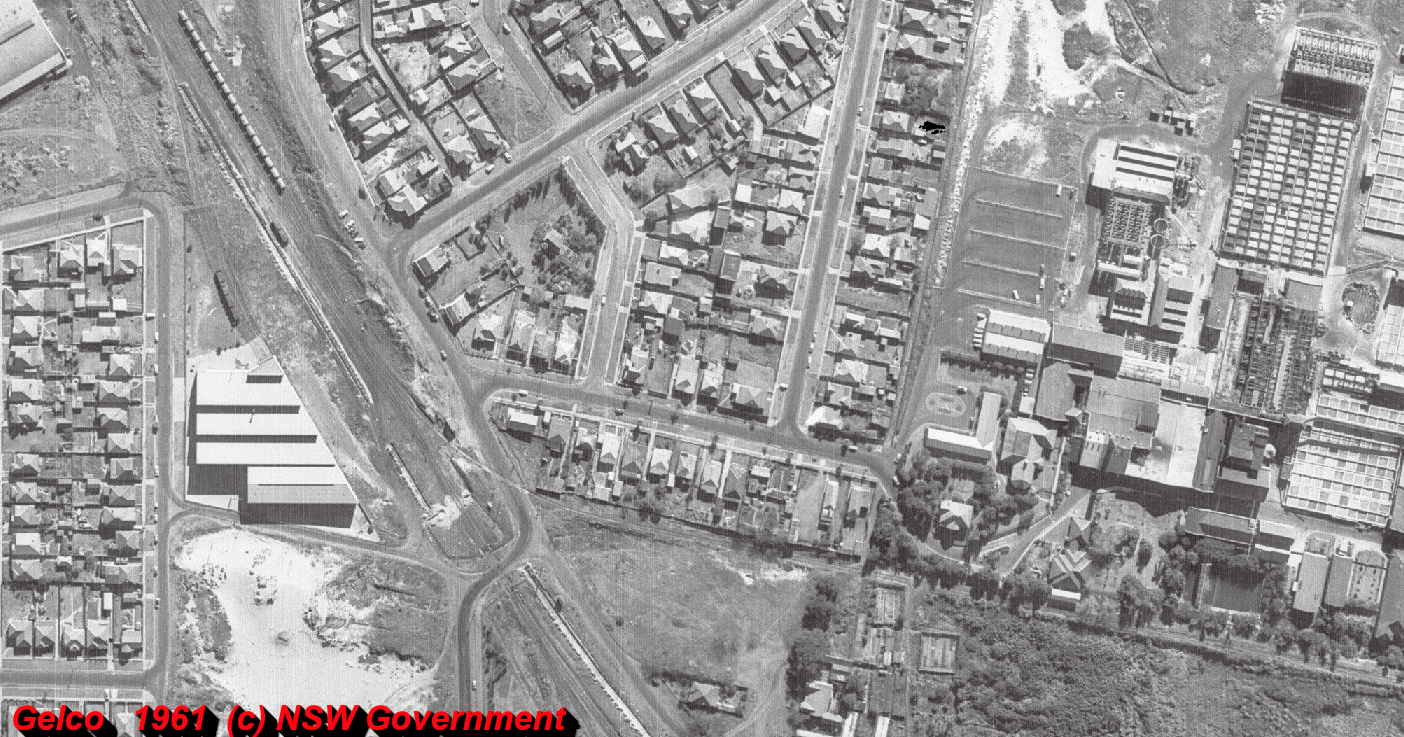


Yellow: Former ICI branch which, while closing decades earlier, is still easier to make out when on location.

--------------------------------------------------------------------------------


When we first dream of building our own model railway empire - whether we’re young or well-advanced in years - many of us imagine cramming as much track as humanly possible onto the available board space.

This often leaves little room for trees, structures, or even the vaguest hint of reality. The result? Trains endlessly looping around, seemingly without rhyme or reason. While this might be entertaining for a while, the novelty tends to wear off quickly. Before long, you'll find yourself drifting back to internet forums, ready to stir up trouble again.

A wise - though delightfully cantankerous - modeller from the far-flung reaches of Wagga Wagga once shared a gem of advice with me: “More is not necessarily better.”

Now, I’ll admit, his actual words were probably far less polite (and unprintable), but the sentiment stuck with me. Painful as it is to acknowledge, this truth has shaped many of the changes I’ve made to my former Tinlow layout over the years.

  Long before this nugget of wisdom graced my ears, though, I had my sights set on a layout inspired by the now-defunct AMPOL branch line. This short stretch of track ran from the Gelco yard at Botany (Sydney) to the now obliterated AMPOL fuel terminal. With its minimal infrastructure and operational quirks, it struck me as the perfect layout for those who enjoy a surplus of locomotives with just a smattering of rollingstock to shuffle about.

Let’s kick off this epic journey with some photos of the line during its twilight years. Stay tuned, because in the coming days, the thrilling AMPOL saga continues!


AMPOL Terminal at the commencement of the refurbishment.
Photo: Brad Peadon


AMPOL Terminal during refurbishment with the sidings having been relaid.
Photo: Brad Peadon


Following refurbishment of the sidings in the 90s.
To the best of my knowledge, which really is not that great, the terminal has never used a rail-based shunter. This beast would be seen shunting the empties/loaded tankers around the small yard there, thus alleviating the need for a permanent shunting loco.
Photo: Brad Peadon


4910 44211 shunt the AMPOL terminal. Baker Street level crossing in the foreground.
Photo: David Xuereb


Not much effort needed for 4827 to push NTAF4037 fron Gelco to the terminal.
Ocean Street - Photo: David Xuereb


48100 pushing tankers over Ocean Street. 
Photo: David Xuereb


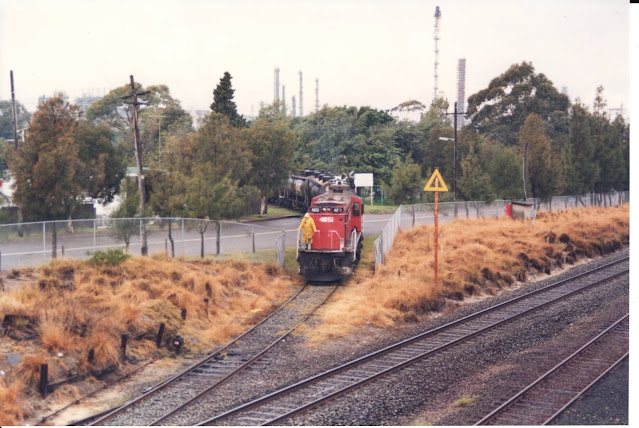
4851 about to pull out a rake of loaded tankers. 
Photo: David Xuereb


4910 44211 at the AMPOL Terminal.  
Both Photos: David Xuereb


44212 shunting the loading bays while the road-based shunter can be seen in the sidings to the left. There were two sidings curving behind that green wall (see part 3)
Photo: David Xuereb


Waiting to cross Ocean Street.  
Photo: David Xuereb


Shunter Steve protects Baker Street as 44212 leads loaded tankers 
out of the terminal.
Photo: Brad Peadon


Changing the points to allow 44211 access to the branch.
Photo: Brad Peadon


Thanks to former local, and lineside companion at Botany for many years, David Xuereb, for use of your photos. Many of which appear in this series.
David lived somewhat closer to the branch than I, so had a lot more opportunity to photograph the daily coming and going.
Hundreds more photos are gradually appearing on our Botany Line research forum.
Photo: Brad Peadon

-------------------------------------------------------------------------------

In part 2 we take a walk along the branch and photograph the line-side structures.


------------------------------------------------------------------------------


-------------------------------------------------------------


-----------------------------------------------------------------------


Thanks to Bradly Coulter, David Xuereb, and the Botany Historical Trust (Eastgardens Library).
Smithston Design & Graphics
Wikipedia
The Story Of The Sydnenham To Botany Railway by Neville Pollard.


Check our new Linktree site above for piles of dreary transport entertainment.
-----------------------------------------------------------------------


Wednesday, January 2, 2008

Ampol Branch - East Botany


Welcome to 2008!

The Ampol branch in East Botany left the Port Botany line just east of the Page Street overbridge and opposite Kelloggs.
It was not a very long branch and was only ever used to serve the fuel terminal at its end. At either end of the line it crossed a street, Baker and Ocean, in between which was a large gelatin company from where Gelco yard gained its name.
In later years this area became quite bushy and was a favoured spot for local Botany railfans, especially in the late 80s and early 90s when it became an obsession with its expected closure.
All shunting was carried out by pushing the fuel tankers into the terminal. There were no run around facilities provided.
Trains would normally work up from Botany yard to the junction, then with the shunter protecting both crossings the train would be called across by radio. On completion the train would return to the junction where it would either head straight out to other destinations or pushed back to Botany goods yard again.
The line closed in the mid 90s after a merging of Caltex and Ampol saw the terminal closed. This came as a bit of a shock as the whole rail section of the terminal was rebuilt just a couple of years prior.
Today the only rails existing are those in the two level crossings. The mainline has been straight railed, while the section between the two crossings has been variously landscaped, covered in a tennis court and also a car park. Only ballast survives in the actual terminal.
No easy access to walking the formation exists, though it can mostly be seen from both crossings.

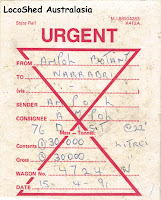
Photos: 4916 arrives at the Ampol terminal on the afternoon of 1st June 1991. Used card from a fuel tanker headed to Narrabri in the states north.

Monday, January 13, 2025

AMPOL - PAGEWOOD BRANCH - PART 3 - REVISED/ENLARGED


Article: Brad Peadon

OPERATIONS

  Information about operations in the early days of the line remains elusive, but by the 1990s, it was common practice for the Botany shunter to visit the terminal and push tankers back to the goods yard. Alternatively, trains often operated directly from the terminal to Clyde and beyond.

  A 1968 goods train timetable suggests that the terminal was regularly shunted by trip trains, likely those departing Botany. However, this doesn’t rule out shunts by the Botany yard shunter, as such movements wouldn’t typically appear in timetables.

  The rolling stock on the line primarily consisted of NTAF fuel tankers serving the terminal. During the steam era, these tankers would have been separated by a match wagon as a safety measure. Occasionally, Kellogg’s NGRX rice hoppers made appearances when their plant was being shunted simultaneously. This raises the possibility of louver vans also being pushed down the branch during Kellogg’s operations, though no concrete evidence of this has surfaced.

Botany also had a shunter’s wagon, which likely became a familiar sight along the branch.

  In terms of locomotives, the line has offered remarkable variety, making it a treasure trove for collectors more interested in motive power than rolling stock. The line opened during the steam era, and while I’m far too young to have witnessed those days, I’ve heard firsthand accounts from those fortunate enough to have seen them. The most common locomotives were standard goods engines, including the 50 and 53 classes. A surviving photo shows 3022 in action, and the 59 class is also believed to have been a visitor.

  There’s also the tantalizing possibility that the 36, 38, and 60 classes, all frequent visitors to Botany, may have ventured onto the branch, although I’ve yet to uncover definitive proof.

  The diesel era provides clearer insights. Over time, the 442, 45, 48, 49, 73, and 82 classes were observed shunting the branch, with several examples documented during the 1990s. Additionally, reports suggest the 44 class occasionally made appearances. This wide range of motive power adds to the line's appeal for enthusiasts and historians alike.

 Although there's no concrete evidence to confirm it, it’s quite plausible that an X200 class locomotive operated on the branch during its time as a Botany shunter. The 41 class, which frequently made trips to Botany, and even the Comeng-built 70 class during their brief Sydney stint, could also have traversed the branch. It’s even likely that the 81 class made appearances.

It’s fascinating to speculate what might have been had the line remained operational. The 80 class, moving into trip working, would almost certainly have seen use on the branch. Later, the prospect of Freight Australia locomotives appearing after their entry into NSW fuel train services adds an even more intriguing "what if" scenario.

By the 2000s, with numerous private operators and a diverse array of locomotives, the possibilities for branch operations would have been endless. Imagining this alternate timeline, if the AMPOL/Caltex merger hadn’t occurred, fuel traffic had persisted on rail, and you had your modeling licenses fully up to date - is truly enjoyable.

----------------------------------------------------------------------
Late Additions:

  Rod Kelly mentions a firewood company that backed onto the line using the line to bring in NODY (open wagons) wagons of product from the North Coast.
 This would then be offloaded over their fence.
  I would assume that this was down the Ocean Street end of the branch, and may well be the reason for the tarred path and timber crossing that appeared in part 2 of this article.

  Roger Renton confirms the use of louver vans, including the huge South Australian ABFX types. He has just scanned a photo of one such movement.

  I cannot thank these guys enough for sharing their memories of the branch, and the Botany line in general.


----------------------------------------------------------------------


3022 is about to cross over the Ocean Street crossing on its way to the terminal. 1968
Photo: Bob Gallagher


48128 and 4837 crossing Baker Street with full tanks from the terminal.
30-4-1996
Photo: Brad Peadon


4908 trundles down the branch as it passes the gates at the Ocen Street end.
Photo: Brad Peadon
----------------------------------------------------------------------

A look at some operations on the line during the last years.

1-6-1991 - 4916 (Candy)
3-12-19914903 (Candy)
27-12-19914917 (Original)
8-1-1992 - 4913 4907 (Candy)
28-4-1992 - 48102 (Red Terror)
2-7-1992 - 4908 (Candy)
8-7-1992 - 4897 (Red Terror)
10-7-1992 - 4897 (Red Terror)
14-7-1992 - 4827 (Candy)
Note: Ban on the branch starts sometime during this period.
25-11-1992 - 48100 (Candy) - First train since reopening after glass particle ban.
9-3-19934917 (Original)
1-5-1993 - 4917 (Original)
1993/94 - 8223 (FR Blue) Only time an 82 noted on the branch.
16-3-1994 - 4902 (Green) - Light Engine
29-4-1994 - 4902 (Green) - 11 in 11 out
30-4-1994 - 4902 (Green)
2-5-1994 - 4917 (Original)
29-1-1996 - 4859 (Candy)
13-2-1996 - 4911 (Original)
26-3-1996 - 4903 (Candy)
27-3-1996 - 44204 44211 (FR Blue)
9-4-1996 - 44204 (FR Blue)
18-4-1996 - 44222 (Candy)
25-4-1996 - 44211 44222 (FR Blue, Candy) - Cab ride to Clyde return.
27-4-1996 - 44212 44215 (Candy, FR Blue) T176
30-4-1996 - 48128 4837 (FR Blue, Red Terror) T220
20-5-1996 - 44212 (Candy) T220
1-7-1996 - 4901 (Green
4-11-1996 - 44211 (FR Blue)
12-11-1996 - 44215 44204 (FR Blue)
Note: 44204 44209 44215 transferred to Werris Creek  24-11-96
26-11-1996 - 4904 (Original)
27-11-1996 - 4904 (Original)
12-12-1996 - 44222 44212 (Candy)
Note: Branch still saw occasional use into 1997.
8-8-1998 - Half of the line pulled up from near Baker Street down to the Ocean Street gates. Crossings and junction still intact.


An afternoon shunt trip to AMPOL heads back to the junction as it approached Ocean Street.
Photo: Brad Peadon


4916 has just left the Botany line and approaches the Ocean Street crossing. It would head out to the terminal before pulling another rake of loaded tankers.
Photo: Brad Peadon


The newly refurbished terminal is shunted by 44212.
20-5-1996
Photo: Brad Peadon

Junction and Ocean Street crossing as seen from the Page Street bridge.
Photo: Brad Peadon


4859 sitting near the Ocean Street crossing awaiting permission to head on to the mainline.
29-1-1996
Photo: Brad Peadon


4818 doing pretty much the same thing. :-)
Photo: Brad Peadon


One short part of the line fools you into thinking that the line isn't within the busy industrial area it runs through.
This was always a much enjoyed photographic spot.
Photo: Brad Peadon


The terminal shunter that moved the tankers around for loading.
Photo: Brad Peadon


4904 crosses Baker Street after shunting the terminal.
Photo: Brad Peadon


48128 and 4837 waiting at Ocean Street like so many others in the series.
30-4-1996
Photo: Brad Peadon

----------------------------------------------------------------------

Modelling The AMPOL branch.

As can be seen, the branch would make a very easy, and quite cheap, model railway to build and operate.
I asked modeller Bradly Coulter if he could outline the current availability of suitable model locomotives and rolling stock.
Please note, that besides the 442, 45, 48, 49, 73, and 82 class, I've seen no photographic evidence as yet to prove that any other classes have ever actually been used.

40 class - Only done by Eureka N/A, but many have modified American RSC3 models (Frateschi have released these now)
41 class - Were done by Austrains. None are currently available, but occasionally show up 2nd hand.
421 class - done by Austrains, Auscision, planned by SDS Models, but might be worth enquiries with Al about LLoyds kit even if just bodies, as can work out mechs later.
422 class - Auscision did the 422 but like most is not available. 
44 class - Trainorama, Auscision both manufacturers have pre-orders available. 
442 class - Austrains & Auscision however neither are regularly available, 
45 class - AR Kits are the only real option and DCC should be possible, Auscision also did them but they are currently not available.
48 class - Powerline, Trainorama, Auscision (they planned to rerun late 2025).
49 class - Trainorama, and announced by Auscision but the order form is not yet available.
Cooties - The original
70 class - IDR models
73 class - Auscision limited liveries still available but repainting fixes unavailable liveries. 
80 class - Austrains, Auscision, SDS Models all presently not available. 
81 class - SDS Models 
82 class - On Track models
X200 - SDS mk1, IDR mk2

Fuel tanks - SDS Models
Various American brands are available for modifications.
Box/Louvre vans - Powerline, SDS Models, On Track, Auscision.


----------------------------------------------------------------------
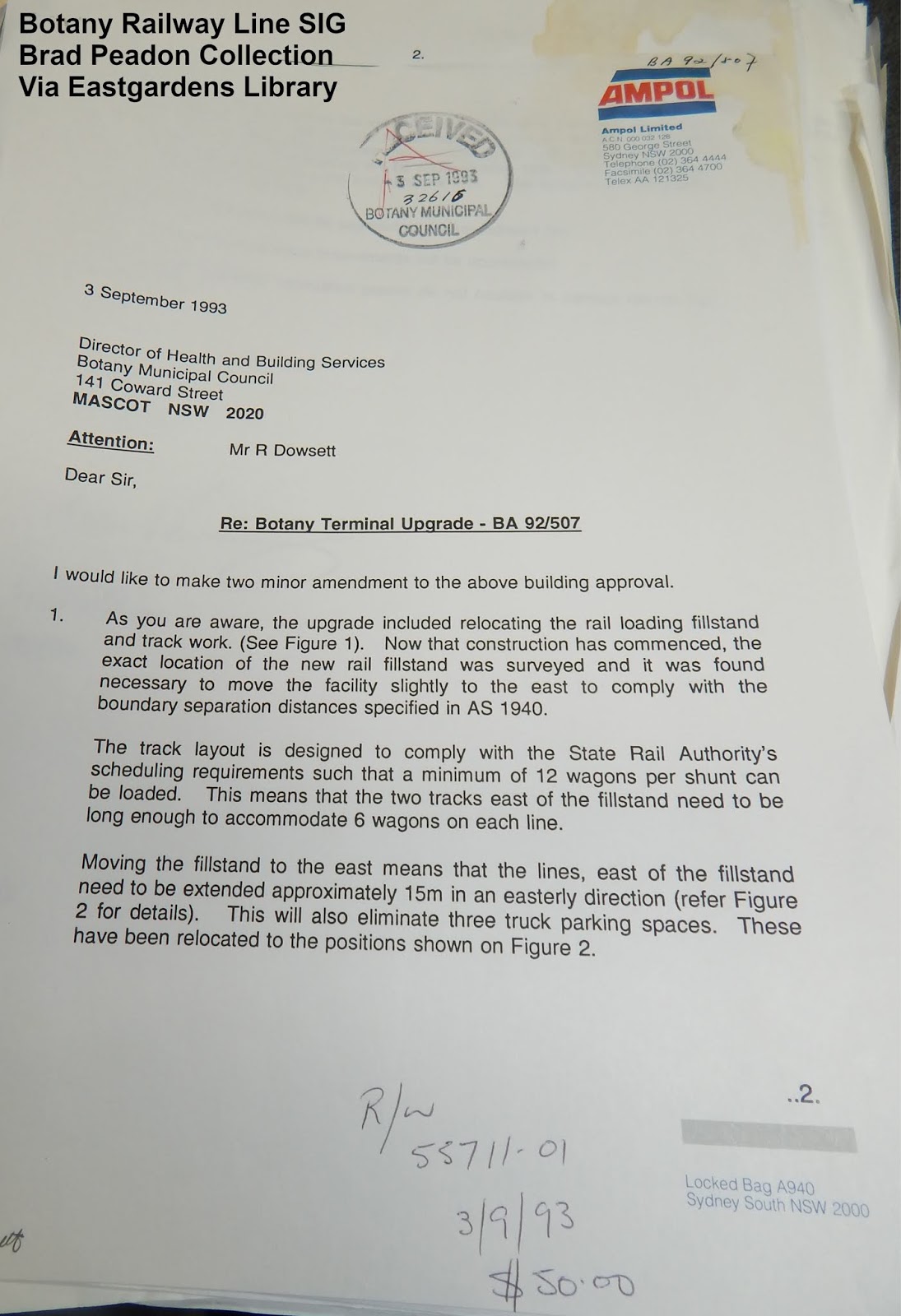
Below are a few of the large number of drawings related to the terminal held by the 'Botany Historical Trust' at the 'Westfield Eastgardens' library.


Gatehouse on Moore Street.


Road vehicle Loading Facility.


New concrete bufferstop.


----------------------------------------------------------------------

----------------------------------------------------------------------

While the research continues, this three-part article is complete.

If you have any information/photos of the former AMPOL Terminal at Pagewood, I would very much love to hear from you. Hopefully, we can find enough information to continue this series.


-------------------------------------------------------------


-----------------------------------------------------------------------


Thanks to Bradly Coulter, Bob Gallagher, Rod Kelly, Roger Renton, David Xuereb, and the Botany Historical Trust (Eastgardens Library).
Smithston Design & Graphics
Wikipedia
'The Story Of The Sydenham To Botany Railway' by Neville Pollard.


Check our new Linktree site above for piles of dreary transport entertainment.
-----------------------------------------------------------------------