The Semi-Retired Foamer has been a railfan since he was around 5 years old, oh yes a very young age, an age when one really should avoid being involved with the gunzel community to any great extent. A few rather unsavoury people bringing that fact home.
After a few decades of train chasing, one decided to break with protocol and get married, thus leading to a severe cut in railfan activity.
Subsequent dealings with hate breeders, lunatics, mental defectives and self-appointed preservation overlords lead to an even greater decrease in my hobby participation.
However things have changed thanks to our small group of trusted mates, interest has returned, and now I have become a bit more involved yet again.
.
_
Over the years I have tried my best to further both the hobby, as well as the friendships that it brings. I have done this by setting up proactive groups both here in Australia, as well as the Philippines. It is with huge honour that I am often considered the founding father of the railfan hobby in the Philippines (my second home).
_
I don't take the hobby too seriously and I am a friend to anyone who is good and genuine. But never forgive those who have used their hate to destroy my hobby or hurt the friends within it.

Let's Make The Hobby Great Again!
I aim to share the era that I considered mine, the 80s and 90s. I also like to help promote, and even raise funds for, the various heritage societies that keep the era alive
_
**** LOCOMOTIVE/ PUBLICATIONS ****
-
We occasionally publish information on the locomotives, and rollingstock, from railways in Australia and the Philippines.
All are available for
FREE at our ALR WEBSITE.


Please email me should you wish to use anything from this site !


Showing posts with label English Electric. Show all posts

Wednesday, July 16, 2025

THE LOCOMOTIVE DIARIES - ENGLISH ELECTRICS PT1


Howdy folks!

So, funny story — if you ignore a photo archive for long enough, it doesn’t magically sort itself. Who knew? After years of neglect (and by “neglect,” I mean blissfully pretending 300,000 photos weren’t piling up like a photographic game of Jenga), I’m now deep in the thrilling world of catch-up.

Sure, I’ve managed to wrangle thousands of images onto this blog, neatly filed under themes like locomotives, trams, infrastructure, and other things that make trainspotters’ hearts flutter. But the reality? There’s still a mountain of unsorted photos sitting around like that one mate who always says he’ll help move house but never turns up.

So, in a stunning act of ambition (or possibly madness), I’m officially launching Operation: Sort My Life Out — a mission to finally tackle the backlog. Expect an avalanche of posts featuring everything from locomotives to buses — basically, if it has wheels and once moved, it’s fair game.

This post kicks things off with a look at the much-maligned but secretly loveable English Electric locomotives of Australia. Yes, I know — fans and drivers have given them grief over the years, often with good reason. But what can I say? I have a soft spot for the misunderstood ones. It’s easy to love something when you don’t have to drive it I guess.

So buckle up (or at least pretend to be mildly interested), because a tsunami of train pics — from the glorious mullets of the 1980s to whatever decade we’re in now — is coming your way. You’ve been warned.

If you have an interest in aviation and other guff, check out my


D27, the last survivor of her type at the Port Kembla steelworks is seen shunting the Cringila Exchange Sidings.
With H5 just arriving at the steelworks, chances are her days are now numbered.
Photos: Brad Peadon


Preserved 507 between Goolwa and Victor Harbor in South Australia.
Photos: Brad Peadon


Bogie of now scrapped K206 at Leightonfield.
Photos: Brad Peadon


K206's nose at Leightonfield.
Photos: Brad Peadon


519 shunting the Keswick passenger terminal in Adelaide, South Australia.
She would be scrapped in 1997.
Photos: Brad Peadon


The somewhat uncommon sight of double headed English Electrics at the Kemira Valley coal loader (BHP Port Kembla).
D51 and D49 are also now scrapped.
Photos: Brad Peadon


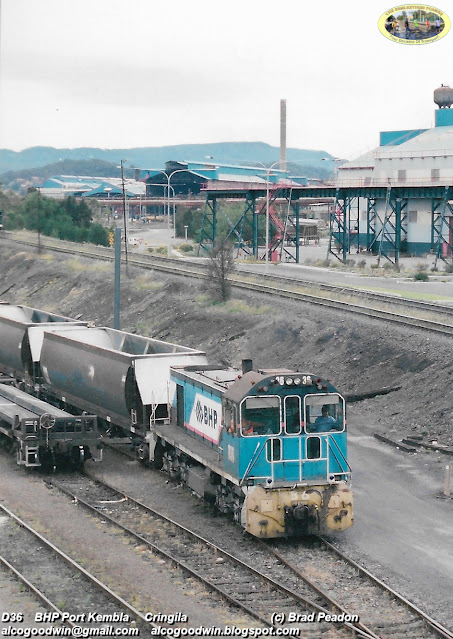
D36 sitting in a siding within the Port Kembla steelworks.
Taken during an official visit.
Like most in this post, she is also scrapped.
Photos: Brad Peadon


K206 and D49 at Leightonfield with containers to Port Botany.
Yep scrapped.
Photos: Brad Peadon


Wow, we have a survivor.
D40 on the CRM shunt at Port Kembla back in the days that steelworks still shunted the place.


The last known remains of D39 from Port Kembla.
Photos: Brad Peadon


D31 D6 lined up in the Brickyard at Port Kembla.
Again, both scrapped. Getting depressing I know.
Photos: Brad Peadon


Now scrapped D28 passing the Cringila Exchange Sidings light engine.
Photos: Brad Peadon


Surviving D27 on another shunt of the Cringila Exchange Sidings.
Photos: Brad Peadon


Preserved 507 at Goolwa in South Australia.
Photos: Brad Peadon


In a scene that can no longer been replicated.
Now scrapped D44 in Port North (South) yard while shunting CRM.
Mainline locos now shunt the sidings via the other end, and NR97 no longer wears the original National Rail livery.
Photos: Brad Peadon


Now scrapped D38 passes the Cringila Exchange Sidings (Port Kembla) with an internal transfer.
Photos: Brad Peadon


D49 and K206 shunting container wagons at Leightonfield yard before racking off forth to Botany.
Both also scrapped.
Photos: Brad Peadon


Now scrapped D44 shunting the Welded Products siding at Unanderra.
Photos: Brad Peadon


D47 D44 D41 amongst others.
18 Area, Port Kembla.
All three are now scrapped.
Photos: Brad Peadon


Former Western Australia K201 stored in Melbourne.
Believed to now be privately owned and destined for preservation in Tailem, Bend (South Australia).
Photos: Brad Peadon


Logbook page from D43 - 24-10-2014.
Photos: Brad Peadon


D31 D6 D32 D16 lined up in the Brickyard at Port Kembla. All have since been scrapped, including preserved D6 (Orange)'
Photos: Brad Peadon


D27, the last survivor of her type at the Port Kembla steelworks is seen shunting the Cringila Exchange Sidings.
Photos: Brad Peadon


D27 and D40 are currently the last two surviving English Electrics in the Port Kembla steelworks.
Their future is in constant danger, and the exact situation at this time is unknown.
Photos: Brad Peadon


Preserved D6 in use shunting the Steelhaven (Port Kembla).
D17 is just visible in the shed, while newly arrived ALCos 103 and 102 can be seen to the right.
Photos: Brad Peadon


At the time restored D6 was earmarked to be preserved, however, in a disgraceful move, she would be scrapped with other units in the lineup.
Sich\kening given how many hours was spent of preserving her at the works.
Photos: Brad Peadon


Above and below:
D17 on torpedo ladle transfers around the works.
The locomotive is now scrapped.
Photos: Brad Peadon


Now scrapped D43 ' Hawks Steelers Wolves' livery on a transfer from CRM to Lysaghts.
Photos: Brad Peadon


D49 D51 on an empty Elouera coal train passing through West Dapto on the now closed Elouera (Wongawilli) branch.
Both are now scrapped.
Photos: Brad Peadon


The BHP Steel K type locos were sold to South Spur following their retirement from the Port Kembla steelworks.
Here two of them, D47 and D51, are seen pulling out of the CTAL Terminal at Port Botany in suburban Sydney.
Photos: Brad Peadon


-----------------------------------------------------------------------


Thursday, July 3, 2025

ALBUMS: PORT KEMBLA STEELWORKS - PART 1


Howdy folks!

Beware, you are approaching another selection of photography showcasing the steelworks at Port Kembla (NSW, Australia).
It has been a particular favourite location of mine over the decades, and I've aimed to try to get many photos of not only the locomotives, but the rollingstock and infrastructure as well.

Prepare for the approaching tsunami of photographs from the 80s till today.

If you have an interest in aviation and other guff, check out my

BHP News - Photos - History.  Come have a squiz.


D44 transferring internal steel wagons through the Cringila exchange sidings.
Unit now scrapped.
Photo: Brad Peadon


D36 shunting the Cringila exchange sidings.
Also now scrapped.
Photo: Brad Peadon


D36 and D44 passing each other at Cringila as they potter around the steelworks.
Photo: Brad Peadon


Above and below.
D40 had just been painted in the new yellow Bluescope Steel livery.
Today she is the last of here type to exist, and has been sitting out of use (awaiting repairs) for some time now. With new (well second hand) locomotives about to be introduced, it is doubtful those repairs will now happen and we are hoping it will see preservation.
Photos: Brad Peadon


The big guy D34 shunting limestone hoppers at Cringila.
Locomotive is now preserved at the 'State Mine Railway' in Lithgow.
Photo: Brad Peadon


Now scrapped D38 also in the then new Bluescope yellow livery.
Photo: Brad Peadon


D7 D20 - 4901 on a special tour up to the Kemira coal loader is seen passing through Mount Kembla.
D7 is privately preserved in Canberra, D20 with the State Mine Railway, while 4901 has been scrapped.
Photo: Carl Millington 
Brad Peadon Collection


D44 was one of the last two units, the other D43, to wear the former red livery. By now it had been modified to carry the new Bluescope Steel logos.
Both D43 and D44 would go on to be scrapped in the red livery, never seeing the attractive BHP blue.
Cringila yard.
Photo: Brad Peadon


D49 (formerly Goldsworthy A8) and D47 (formerly Goldsworthy A5) wait at Wongawilli Junction with a load of coal from the Elouera Colliery branch.
Both are now scrapped.
Photo: Brad Peadon


D47 again, now on an empty coal rake headed up the Kemira line.
Photo: Brad Peadon


D43 shunting the Welded Products siding at Unanderra.
Photo: Brad Peadon


D49 D47 up Elouera coal at West Dapto.
Photo: Brad Peadon


D36 at Cringila again, as it likely was a million times before scrapping.
Photo: Brad Peadon


D38 Light engine passing through Cringila.
Photo: Brad Peadon


8115 waits at Brownsville Junction with a coalie from Elouera. The second and third hoppers were a couple of the special livery hoppers that existed.
Photo: Brad Peadon
-

The National Railway Equipment PB class (genset) now represent the main type of locomotives at the steelworks, having seen the demise of all remaining English Electrics other than D27 and D40.
They will soon be assisted by four second hand Victorian H class which are in the process of being transferred there.
Above and below is PB3.
Photos: Brad Peadon


An extract from the logbook of now scrapped D43.
Photo: Brad Peadon


Above and below.
The round sided (143-180) BXLA coal hoppers.
Today the entire fleet is believed scrapped (as are the older square sided (1-142) variation.
Photos: Brad Peadon


Above and below
Torpedos during transfers through Cringila, a sight that does not seem anywhere near as common as it once seemed to be. Maybe I'm just picking bad days to visit.
Photo: Brad Peadon


Internal wagon LR-119.
Photo: Brad Peadon


Internal wagons CR-34 and CR67 with a load of steel coils at Spring Hill.
Photo: Brad Peadon


Bushells Hill tunnel on the Kemira Valley line.
Photo: Brad Peadon


Former line to Nebo Colliery, today being a bike/walking track.

Photo: Brad Peadon


The same section today.

Photo: Brad Peadon


Battery locomotive #78 at Nebo Colliery.
Photo: Brad Peadon
-----------------------------------------------------------------------


-----------------------------------------------------------------------

All who have partaken in my steelworks adventures with me.


Check our new Linktree site above for piles of dreary transport entertainment.
-----------------------------------------------------------------------

I never thought orthopedic shoes would really work for me, but I stand corrected. 👞👞