The Semi-Retired Foamer has been a railfan since he was around 5 years old, oh yes a very young age, an age when one really should avoid being involved with the gunzel community to any great extent. A few rather unsavoury people bringing that fact home.
After a few decades of train chasing, one decided to break with protocol and get married, thus leading to a severe cut in railfan activity.
Subsequent dealings with hate breeders, lunatics, mental defectives and self-appointed preservation overlords lead to an even greater decrease in my hobby participation.
However things have changed thanks to our small group of trusted mates, interest has returned, and now I have become a bit more involved yet again.
.
_
Over the years I have tried my best to further both the hobby, as well as the friendships that it brings. I have done this by setting up proactive groups both here in Australia, as well as the Philippines. It is with huge honour that I am often considered the founding father of the railfan hobby in the Philippines (my second home).
_
I don't take the hobby too seriously and I am a friend to anyone who is good and genuine. But never forgive those who have used their hate to destroy my hobby or hurt the friends within it.

Let's Make The Hobby Great Again!
I aim to share the era that I considered mine, the 80s and 90s. I also like to help promote, and even raise funds for, the various heritage societies that keep the era alive
_
**** LOCOMOTIVE/ PUBLICATIONS ****
-
We occasionally publish information on the locomotives, and rollingstock, from railways in Australia and the Philippines.
All are available for
FREE at our ALR WEBSITE.


Please email me should you wish to use anything from this site !


Showing posts with label Trains. Show all posts

Monday, September 15, 2025

ALBUMS: SPARKS NSW PT2


Hey there spark fans!

One of the consequences of neglecting to catalog over 300,000 photos over the years is that I’m now in full catch-up mode. While I’ve managed to organize thousands of images across various themes here on the blog, there are still many more waiting for their turn in the spotlight.
To tackle this backlog, I’m diving headfirst into sorting and categorizing a large portion of these photos in the coming months.
You can look forward to endless dreary posts focused on locomotives, carriages, infrastructure, trams, and buses—perfect for anyone with even a passing interest in these fascinating subjects. Or not ..... that choice is up to you


I have to admit that sparks were never really on my radar and the vast majority of photographs were either during some special event, or just to pass those endless boring hours waiting for the good stuff to arise.
Of course, as time progressed and the older sets start going to train heaven, I began to regret not getting my rear more into gear and cover more of this guff.
More recently I have actually made an effort to cover the greatly endangered old K and V sets which, I guess, is probably to little to late.
Anyway, it is what it is.
Feel free to enjoy what I do have to share, or more likely to hate given many of the rabid attitudes out there. Either way, thanks for looking.

For Locomotive & Tram - Updates - Status - Photos.

-------------------------------------------------------------


Once upon a time I used to be semi-living in the fiancée's parents house in Rockdale which gave me cause to regularly be at the railway station.
 For a period you would find a red set (the Zoo Train on at least one occasion) sitting in this old, now removed, siding of a weekday afternoon.
Photo: Brad Peadon


Who got to enjoy a 3 car Y set ride up to Carlingford?
This was one such occasion for me.
Today the red sets are gone, those sidings are also wiped, while the line itself has been converted to light rail.
Photo: Brad Peadon


Y2 has arrived back at Clyde station which was the junction for the former Carlingford and Sandown lines.
Photo: Brad Peadon


S65 approaching Marrrickville station with the second carriage being an old Tulloch built example.
Photo: Brad Peadon


Passing the rather interesting, but architecturally dreary, Macdonaldtown station.
Photo: Brad Peadon


The good ol days when you could hop off one of these fast ol girls and hope on a railcar out along the now abandoned Toronto branchline.
Photo: Brad Peadon


Another abandoned branchline, this time the Warwick Farm Racecourse, with C3340 sitting at the end of set H2 and waiting to take the punters home.
Photo: Brad Peadon


H2 departing the Warwick Farm Racecourse platform.
This was one of the final departures on the last day of operations.
Photo: Brad Peadon


H3 entered the history books as the last train to even depart the Warwick Farm Racecourse branch.
C7500 T4612 T4772 C7488 C7392 T4767 T4627 C7411.
Photo: Brad Peadon


T4612 earlier in the day.
Warwick Farm Racecourse.
Photo: Brad Peadon


Finally, a line that has not yet been abandoned, in fact it was the early days of the East Hills line extension to Glenfield. That's the new Holsworthy station in the background.
B8 is seen headed westward and  I was out for a days photography with the late Bruce Cook.
Photo: Brad Peadon


Only around four cars received this yellow front livery, one of them found here on the front of R21 between Ashfield and Summer Hill.
Photo: Brad Peadon


DJM-8106 leads set V39 into Broadmeadow station late one afternoon.
By chance, she lead our train to Katoomba on a recent day in the Blue Mountains getting these classic trains in their final weeks.
Photo: Brad Peadon


V2 on the Carlingford line again, this time approaching Camellia. It is hard to believe this section is now a modern double track light rail system.
Photo: Carl Millington
Brad Peadon Collection


Many rave on about the original blue fronts being the best livery that the V sets have worn, but for me it was the candy.
Sorry.
Photo: Brad Peadon


Another candy set, this time V19.
Photo: Carl Millington
Brad Peadon Collection


One of the original blue front sets I just mentioned.
V3 is passing over the Sydney Harbour Bridge and about to plunge into the Sydney underground.
Photo: Carl Millington
Brad Peadon Collection


T13 displaying how the Tangara once appeared.
Photo location was atop a big carpark which has since been demolished.
Photo: Brad Peadon


Tangara crossing the Meadowbank bridge during our annual SRF/SMUT combined lineside Christmas party,
These will soon be the eldest sets in the fleet.
Photo: Brad Peadon


H23 stops at Berala station.
Photo: Carl Millington
Brad Peadon Collection


Another blue V set seen passing one of the most beautiful locations on the system.
Clifton on the New South Wales South Coast line.
Photo: Brad Peadon


If you know the Chatswood of today, you will likely be stunned to see what it used to look like.
Tangara T17 back how they originally looked.
Photo: Brad Peadon


H24 touches down at Campsie station with a citybound service.
This line to Bankstown is in the process of being converted to a Metro system and will connect at Sydenham with the current Metro to Tallawong.
Photo: Brad Peadon


B14 also at Campsie, this time headed towards Bankstown.
Photo: Brad Peadon


Sadly the majority of my blue/white carriage shots are back in my earlier days when still enduring an Instamatic camera.
Pretty sure that is a young David Henderson watching set H4 arrive at Milsons Point (first station north of the Sydney Harbour bridge seen in the background).
Photo: Brad Peadon

-----------------------------------------------------------------------
The following selection photos were taken by Carl Millington 
and show a Zoo Train tour to interesting
 locations around Sydney.


Above & Below
Helensburgh.


Above & Below
Richmond line.
Above: Mulgrave
Below: Rickabys Creek


Above & Below
Sandown


-
-----------------------------------------------------------------------


-----------------------------------------------------------------------

Lee Davis & Kevin Medley.


Check our new Linktree site above for piles of dreary transport entertainment.
-----------------------------------------------------------------------


#semiretiredfoamer


Tuesday, January 7, 2025

AMPOL - PAGEWOOD BRANCH - PART 2 - REVISED/ENLARGED


Article: Brad Peadon

THE BRANCH

  The AMPOL (Total) branch wasn’t very long - just 664 metres (2,178 feet) - essentially more of an extended siding. However, this modest stretch held plenty of interest for railway modellers.

  The line branched off just east of today’s Page Street overbridge, with the points facing Marrickville, where it passed through a boundary gate and immediately crossed Ocean Street on a curve. This was the first of two level crossings along the line. At the time, Ocean Street was a major thoroughfare for traffic from Botany and was protected by manually operated Type F flashing lights from 1958.

 These lights likely became obsolete after the Page Street Overbridge opened on December 4, 1979, reducing Ocean Street’s traffic significantly. Remarkably, the derelict remains of these lights persisted into the mid-1990s, possibly until the branch’s closure, when most signage and rail were removed.

  After crossing Ocean Street, the line curved slightly more, traversing the driveway of a nearby house before entering a narrow right-of-way. The track ran between the back fences of Young Street houses on one side and industrial estates on the other. The industrial area was level with Anderson Street, which elevated the branch along much of its length. Beyond the Young Street properties lay the expansive grounds of Davis Gelatin.

 By 1993/94, the closest structure to the railway formation - an office building - was derelict. Today, it has been refurbished and now operates as the Treehouse Restaurant. Although Davis Gelatin’s property spanned from Page Street to Anderson Street, no record of a formal agreement involving the railway line exists.

   The branch continued northeast, passing another warehouse, crossing Baker Street, and entering the AMPOL terminal. This terminal opened in 1955 under the name ‘United Petroleum Ltd’ and underwent several name changes: to ‘Anglo United Petroleum Ltd’ in 1957, ‘Total Oil Products Australia Ltd’ in 1958, and finally, AMPOL in 1984 after purchasing Total. Despite these changes, the branch remains commonly referred to as the ‘Total branch.’

  Baker Street was a quieter place back then, with simpler Type B crossing signage. Since its opening in 1958, the terminal’s yard layout underwent three transformations before its closure, with the last refurbishment occurring in 1994, only a few years before the branch ceased operations.

  See below for the various track layouts.

The State of the Branch in 2025

  Today, very little of the old branch remains visible. Extensive roadwork on Ocean Street has erased most traces of the track, though a small section of rail can still be found on the terminal side of the street, along with the mostly buried base of the former crossing lights.   However, all evidence of the Baker Street crossing, including an aged crossing sign that long outlasted the line, has been obliterated. A shallow cutting still marks the junction, but the rest of the formation has been fenced off, landscaped, and partially developed over.


Looking at the south-east corner of the now obliterated intermediate staff hut which was situated between the junction and Page Street bridge.  
Photo: David Xuereb


The intermediate staff hut again, this time being inspected by the legendary Daven Walters.  
Photo: David Xuereb


Inside the intermediate staff hut showing the staff instrument.   
David Xuereb Collection


Above and below.
Point rodding between the levers and junction points.  
David Xuereb Collection.


Above and below.
Junction points. Ocean Street crossing just beyond that fenceline.  
David Xuereb Collection.


Ok, I admit I had no idea what the thing above actually does, so I decided to ask on the Botany Railway Line SIG and got the following two responses.  

John Pitcher
That would be a drawer lock style releasing device. Basically the Annette key goes in and unlocks another key (drawer key) that is used for the branch.

Ben Dihen
Don’t forget to place the staff in the drawer first otherwise you can’t get the key out.

David Xuereb Collection.


Above and below.
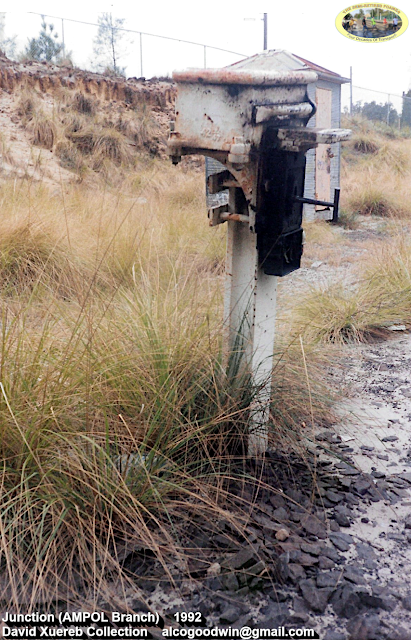
Point indicator at the junction of the branch.   
David Xuereb Collection


Point levers for the branch which is seen diverging to the left.  
Photo: David Xuereb


A recent photo of the former junction from Ocean Street.
Recent road works have obliterated most signs that this was once a railway.  
Photo: Brad Peadon


Above and three below.
The Ocean Street level crossing back when the branch was still in use. The crossing lights, and the activation button on the short pole beside, were not in use.  
Photo above: Brad Peadon
Three below:David Xuereb Collection 


Above and below.
The Ocean Street crossing following major work to remove the remains of the crossing.  
Above is looking towards the terminal, the other being towards the junction.
Photo: Brad Peadon


From Ocean Street the former right of way is seen looking in the direction of the former terminal.  
Access to this section is not possible now.
Photo: Brad Peadon


The very last bit of remaining rail on the entire branch.  
However, it is thought all that across Ocean Street is probably under the tar.
Photo: Brad Peadon


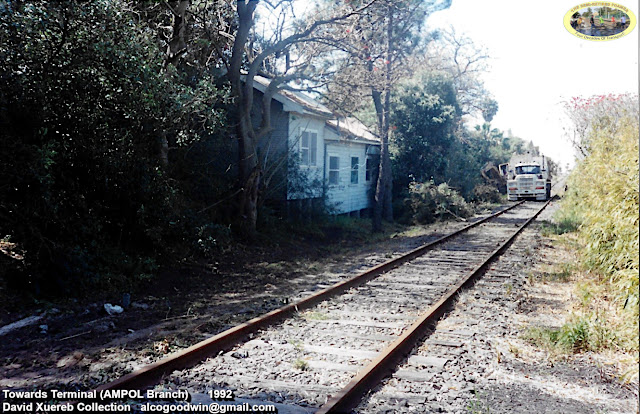
Curve just beyond Ocean Street, looking towards the terminal.
David Xuereb Collection


A wee bit further from the above spot.
David Xuereb Collection


An early shot of an Indian Red 73 class shunting the branch.
Photographer: Unknown. 


Above and below.
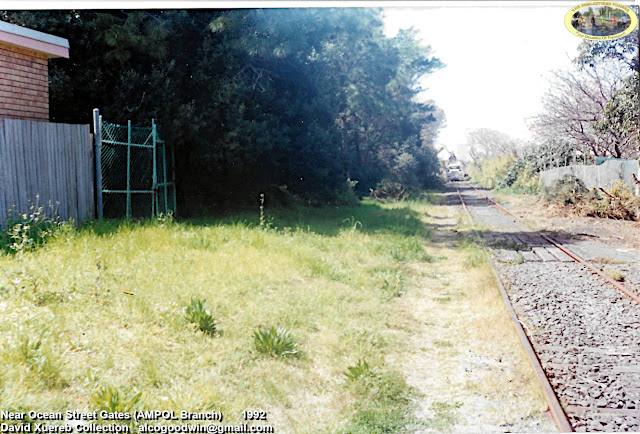
Gates at the Ocean Street end of the branch.
I can't recall a time I saw these closed during my 90s visits to the line.
David Xuereb Collection


Gates at the Ocean Street end of the branch during removal and remediation work.
Photo: Brad Peadon


Above and below.
Other random branch shots showing lineside structures.
Photos: David Xuereb


The legendary Stephen Miller on a tarred path that ran from the east side of the line to a crossing made of sleepers.
There was no continuation of the path on the west side, and the purpose of it is still unknown.
Photo: David Xuereb


Above and below
Stephen J Miller exploring the branch with a Jumbo visible shunting the terminal in the distance.
Photo: David Xuereb

--------------------------------------------------------------
The following images, either taken by David Xuereb (ummarked), or are from his collection, show the section through land owned by David Gelatine.


Can't recall why the truck was there.
As the plant had closed, It may have been part of the demolishing process.
David Xuereb Collection


Buildings in the former Davis Gelatine plant before being torn down.
Photo: David Xuereb


Davis Gelatine property to the east of the branch, with the massive Kellogg's plant in the distance.
Photo: David Xuereb


Above and below
More small buildings that were part of the Davis Gelatine plant.
David Xuereb Collection above
David Xuereb below.


Above and below
Davis Gelatine water treatment plant between the railway and Anderson Street.
Photos: David Xuereb.


Pipe between the water treatment plant and main production area.
Photo: David Xuereb.


--------------------------------------------------------------
Baker Street crossing and terminal.


Factory on south-west corner of Baker Street crossing.
Photo: David Xuereb


Looking across Baker Street and into the terminal.
David Xuereb collection.


Baker Street looking back towards the junction.
Photo: Brad Peadon.


The last surviving railway remnants on Baker Street before they were also removed.
Images: Courtesy of Google Streetscape.


Former rail entrance into terminal from Baker Street.
No trace of this formation still remains.
Photo: Brad Peadon.


Aerial image from the 1937 'Davis Gelatine Review' with the tree line marking out where the railway would eventually run.
The smaller build near the bottom is still there today.


Ampol Terminal in 1985.
At the time there was no loading gantry.
Photo: National Library of Australia 


There be more to come in Part 3.

We would like to hear from anyone who is able to contribute more photos or information on the AMPOL branch for us to include in a future update or possible part 4.
Did you work on it, work at the terminal, shunt train over it, or just take some photos?
Please email us at our alcogoodwin email address.


Botany Railway Line SIG - You're Invited To Join us.

-------------------------------------------------------------


-----------------------------------------------------------------------


Thanks to Josh Beveridge, Bradly Coulter, Ben Dihen, Doug Erskine, John Pitcher, Roger Renton, David Xuereb, and the Botany Historical Trust (Eastgardens Library).
Smithston Design & Graphics
National Library of Australia
Google Maps/Earth
Wikipedia
The Story Of The Sydnenham To Botany Railway by Neville Pollard.


Check our new Linktree site above for piles of dreary transport entertainment.
-----------------------------------------------------------------------